
Why Handwritten Thank-You Letters Still Win: A Smarter Way to Increase Customer Retention
There is no shortage of ways to communicate with customers. Email automations. Retargeting ads. SMS. Push notifications. AI chat. Somewhere in that constant stream of digital noise, many companies have lost sight of one of the simplest, most effective relationship-building moves in business:
Say thank you like you mean it.
Not with a bland footer line. Not with a canned email that pretends to be personal. A real handwritten thank-you—specific, thoughtful, tangible, and human.
That is why handwritten letters still matter. They feel intentional in a world that feels increasingly automated. And that matters, because customers notice when they are treated like transactions instead of people. Salesforce reports that 66% of consumers are likely to switch brands if they feel treated like a number rather than an individual, while its more recent customer research shows the pressure on brands to personalize is only increasing.
Gratitude is not soft. It is economic.
For all the talk about growth, businesses often overlook the most obvious source of it: the customers they already have.
Harvard Business Review notes that acquiring a new customer can cost five to 25 times more than retaining an existing one. Bain research, cited by HBR, also found that increasing retention by just 5% can lift profits by 25% to 95%.
That changes the math on a thank-you note.
If a well-timed handwritten letter helps save one renewal, generate one referral, one positive review, prompt one repeat order, or strengthen one client relationship, the ROI can be disproportionate to the cost. Sending an automated handwritten thank-you costs less than a cup of coffee.
That is the point: this is not an expensive loyalty strategy. It is a surprisingly affordable one.
Why handwritten thank you cards work differently
Handwritten mail stands out because it carries emotional weight. It feels slower, more deliberate, more considered.
Handwritten direct mail gets opened because it feels personal. Marketers have reported open rates as high as 99% for hand-addressed mail, and broader industry benchmarks put direct mail open rates at up to 90%. Add a real stamp and a local-looking presentation (without an out of state postmark), and it grabs attention in a way almost no other channel can. USPS-backed research also shows physical mail holds attention longer, creates stronger emotional response, and is remembered better than digital media.
That makes handwritten thank-you letters powerful for a simple reason: they do not feel like marketing, even when they support marketing outcomes.
And there is research specifically on handwritten notes. A randomized field experiment published in the Journal of Interactive Marketing found that including a handwritten note had a positive and significant effect on customer spending, particularly among customers who already had some loyalty to the brand.
In other words, gratitude is not just nice. It can move behavior.
The real unlock: automate handwritten thank-you notes in your CRM
The biggest reason most businesses fail to do this consistently is not philosophy. It is workflow.
Everyone likes the idea of handwritten thank-you notes. Very few teams want to rely on someone remembering to write them after every sale, renewal, referral, milestone, or onboarding moment.
That is where CRM automation changes everything.
When handwritten thank-yous are integrated into your CRM, they stop being random acts of goodwill and become a repeatable part of the customer experience. A note can be triggered automatically when:
- a deal closes,
- a new client is onboarded,
- a subscription renews,
- a customer hits an anniversary,
- a donor gives for the first time,
- a referral is received,
- or a high-value order ships.
The result is simple but powerful: you create authentic customer moments at scale.
And unlike old-school direct mail, modern mail can also be measurable. Direct-mail platforms now support QR codes, personalized URLs, unique phone numbers, and attribution workflows, making it easier to connect offline outreach to real business outcomes. VentureStack, for example, reported 8.3x return on ad spend from direct mail campaigns in a Lob case study.
How this works across industries
Professional services
For law firms, accounting firms, financial advisors, agencies, insurance firms, and consultants, the relationship is the product as much as the technical work.
A handwritten thank-you after onboarding, after a successful project, or after an annual review reinforces trust. It tells the client they are not just another account in a system. In relationship-driven businesses where renewals and referrals matter, that small signal can carry a lot of weight.
E-commerce
E-commerce brands often spend heavily to acquire customers and far too little to deepen the relationship after the purchase.
That is a mistake.
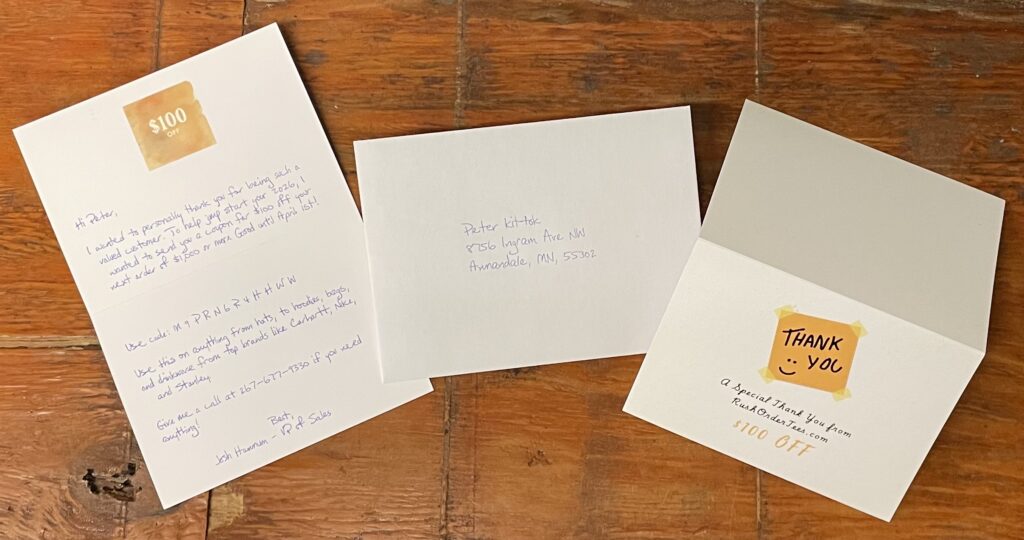
Imagine a first-time customer receives a handwritten thank-you after their order arrives. Or a top customer gets a note after their fifth purchase. Or a subscription customer gets one on their anniversary. Those are the kinds of moments that turn a brand from transactional to memorable.
And the research backs that up: the field experiment on handwritten notes found a lift in customer spending, especially among already-loyal customers.
Automotive
Automotive is full of natural thank-you triggers.
A salesperson can send one after a vehicle purchase. A service advisor can send one after a major repair or a first visit. A dealership can trigger one at the one-year purchase anniversary or after a referral.
Cars are emotional purchases. Service is trust-based. A handwritten note helps the relationship continue after the transaction, which is exactly where long-term value is created.
Real estate
Real estate is one of the best use cases for handwritten thank-you outreach.
Agents can send notes after closings, after referrals, on move-in anniversaries, after open houses, or after helping a client with a contractor recommendation. It reinforces a crucial message: I am still here, and I still care, even after the deal is done.
That matters because the long-term value in real estate often comes from repeat referrals and future transactions, not just the initial commission.
Nonprofits
Nonprofits should absolutely be in this conversation.
A donor thank-you is not just stewardship—it is retention strategy.
According to The Fundraising Effectiveness Project, Nonprofits continue to face tough donor retention headwinds, making thoughtful donor appreciation a critical part of long-term fundraising success.
That is exactly why meaningful appreciation matters.
A handwritten thank-you note to a first-time donor, recurring donor, volunteer, event sponsor, or major giver can help a nonprofit feel more human and less transactional. It can reinforce that the gift mattered, that the donor was seen, and that the relationship is about more than the next ask. In a sector where donor retention is notoriously difficult, those signals matter even more.
Other strong fits
The same strategy works in:
- healthcare and dental practices,
- home services,
- B2B SaaS,
- higher education,
- hospitality,
- franchise systems,
- wealth management,
- and membership organizations.
Anywhere trust, repeat behavior, referrals, renewals, or loyalty matter, a handwritten thank-you note can have outsized impact.
What makes a thank-you note actually effective
Not every thank-you note works.
The good ones are:
- timely,
- brief,
- specific,
- human,
- and free from obvious sales pressure.
The point is not to disguise a promotion as gratitude. In fact, the handwritten-note field experiment found that adding an extra giveaway could weaken the effect, suggesting the real power came from perceived warmth and authenticity—not from piling on incentives.
The best thank-you notes usually do three things:
- Use the person’s name.
- Reference something real.
- Express appreciation in plain language.
That is enough.
The strategic takeaway
The companies and organizations that win on retention are not always the loudest. Often, they are the ones that make people feel recognized.
That is why handwritten thank-you letters still work.
They create emotional resonance. They make customers, clients, and donors feel seen. They support retention. They can encourage repeat purchases, renewals, referrals, and future giving. And when they are automated intelligently inside your CRM, they become scalable without becoming robotic.
So yes, a handwritten thank-you is a nice gesture.
But it is also more than that.
It is a loyalty lever. A retention tactic. A brand signal. A way to humanize automation. And often, it can be done for less than a cup of coffee.
Because in a world full of digital noise, a real thank-you still lands differently.